
Technical crawler
Observe the current site: routes, indexability, metadata, canonicals, links, on-page checks, affected URLs, and crawl-to-crawl movement.
SearchSignal combines measured performance, technical crawl evidence, saved project research, clearly labeled estimates, and licensed Pro data in one workspace. Source and freshness context should remain attached to every important decision.
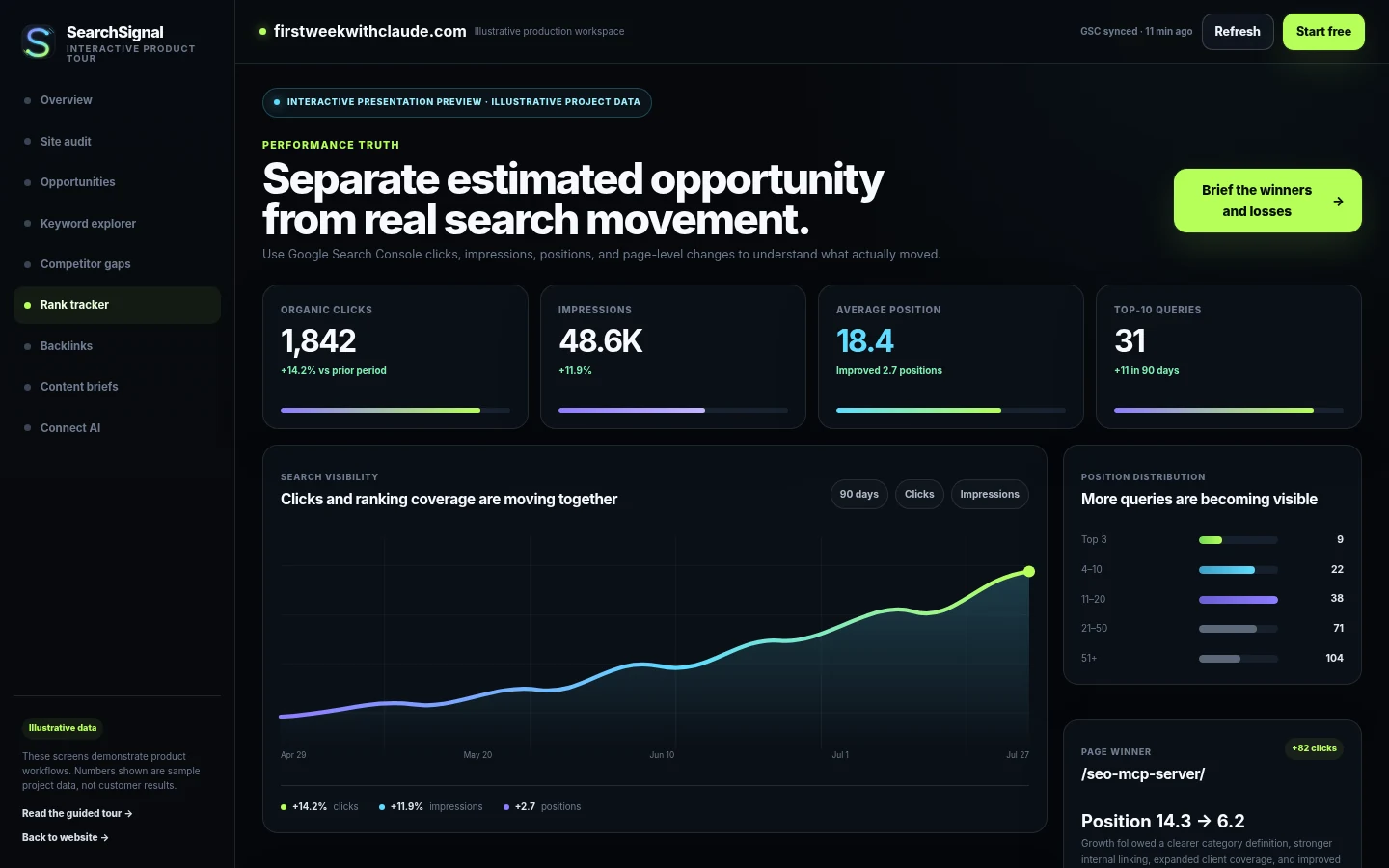
A commercial SEO platform should not flatten measured performance, crawl observations, market estimates, and human research into one unlabeled number.
Observe the current site: routes, indexability, metadata, canonicals, links, on-page checks, affected URLs, and crawl-to-crawl movement.
Use measured clicks, impressions, positions, query movement, and page performance to see what actually happened in search.
Use clearly labeled keyword and opportunity estimates to explore the workflow before licensed market data becomes necessary.
Add Google Ads volume, CPC, difficulty, organic SERP data, and live backlink evidence through the published Pro data path.
Availability and limits should be enforced by the existing production backend. This presentation reflects the published Free and Pro product model.
| Source | What it contributes | How it should be labeled | Plan path |
|---|---|---|---|
| SearchSignal crawler | Technical and on-page findings, affected URLs, health, issue history, internal-link evidence | Observed crawl data with crawl time | Free: up to 25 pages · Pro: up to 75 pages |
| Google Search Console | Clicks, impressions, average position, query and page movement | Measured Google performance with sync time | Published on Free and Pro |
| Free keyword layer | Exploration, ideas, intent, estimates, lists, and workflow proof | Estimate wherever the value is not licensed Google data | Free and Pro |
| Licensed keyword and SERP data | Google Ads volume, CPC, difficulty, and Google organic result context | Licensed third-party market data with retrieval time | Pro |
| Backlink data | Referring domains, live link evidence, losses, target routes, and recovery context | Imported or live source identified explicitly | Free import/core context · live Pro depth |
| Saved project research | Keyword lists, competitors, briefs, decisions, status, ownership, and working context | Workspace research with editor or event time | Free and Pro |
When an agent acts on stale or ambiguous evidence, polished output can still be wrong. SearchSignal’s commercial presentation should keep freshness and provenance in the working view and agent response.
{
  "metric": "average_position",
  "value": 18.4,
  "source": "google_search_console",
  "measured": true,
  "synced_at": "2026-07-27T14:51:00Z"
}

{
  "metric": "monthly_searches",
  "value": 2900,
  "source": "licensed_keyword_provider",
  "measured": false,
  "retrieved_at": "2026-07-27T13:08:00Z"
}The strongest workflow lets agents retrieve, synthesize, and prepare work while retaining human review for business priorities, factual claims, destructive actions, and production changes.
Request source timestamps and coverage before treating a workspace pack as a complete current picture.
Do not present estimates as measured performance or saved human research as an external market fact.
Opportunity order is a decision aid. Business constraints and implementation risk still belong in the approval loop.
Rerun the crawl, inspect the deployed page, and watch measured search movement rather than declaring success at commit time.
Measured performance, crawl observations, estimates, licensed metrics, and saved research should never be blended into one unexplained number.
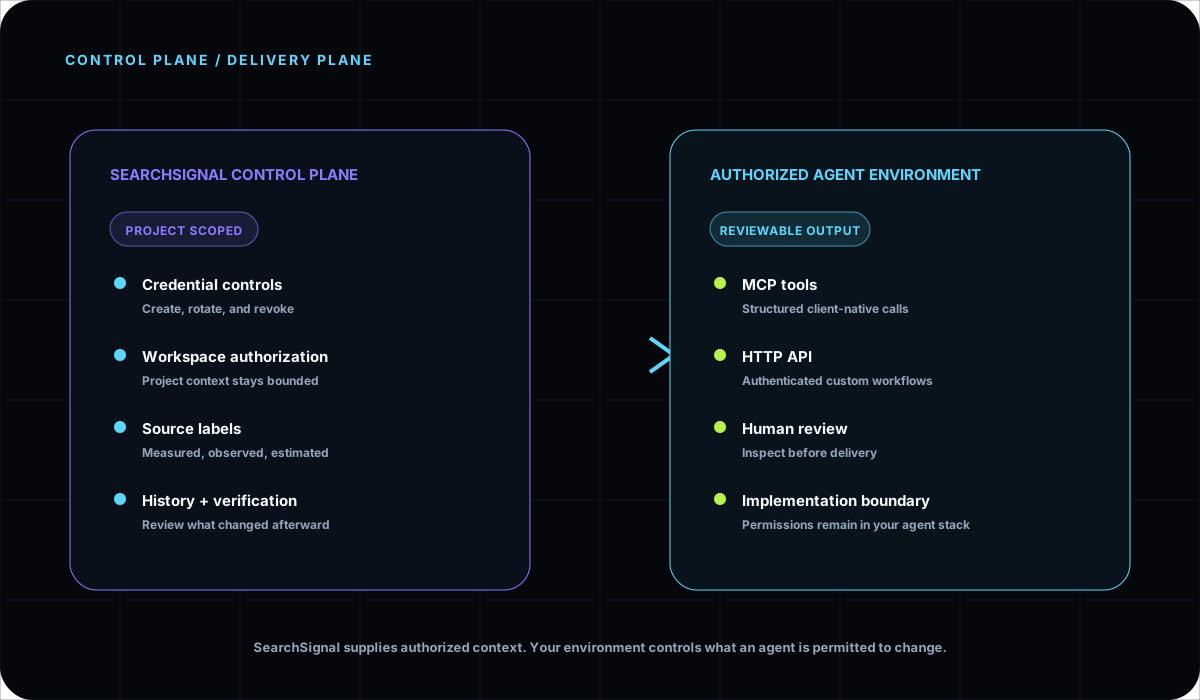
Create a SearchSignal workspace, connect one credential, and move from SEO questions to prioritized work without leaving your agent.